Part 8 of 8 — Director Education: An Association Imperative. This final post connects the series into one system for continuous director education.
Think back to the last new director your board seated. Somewhere in the first ninety days, someone handed them a binder. Then they walked the new director through the bylaws, pointed out the conflict-of-interest form, and called it orientation. Eighteen months later, that same director is voting on a scenario-based strategic bet. They are also evaluating the CEO’s performance and weighing an AI vendor proposal. Yet they have no more preparation than the binder gave them.
That gap is not a training oversight. It is a design flaw, and this series has spent seven posts naming its pieces. This final post installs the system that holds them together.
Why Continuous Director Education Needs a Learning Architecture
Every post in this series has pointed at a different competency: role clarity, disciplined curiosity, systems thinking, scenario fluency, digital and AI literacy, and adaptive leadership. Naming competencies is useful, but a list of skills is not a program.
Associations don’t need a better orientation. Instead, they need a learning architecture. That structure treats director education as a continuous practice, not an event that happens once and gets checked off.
The Six-Step Cycle at the Center
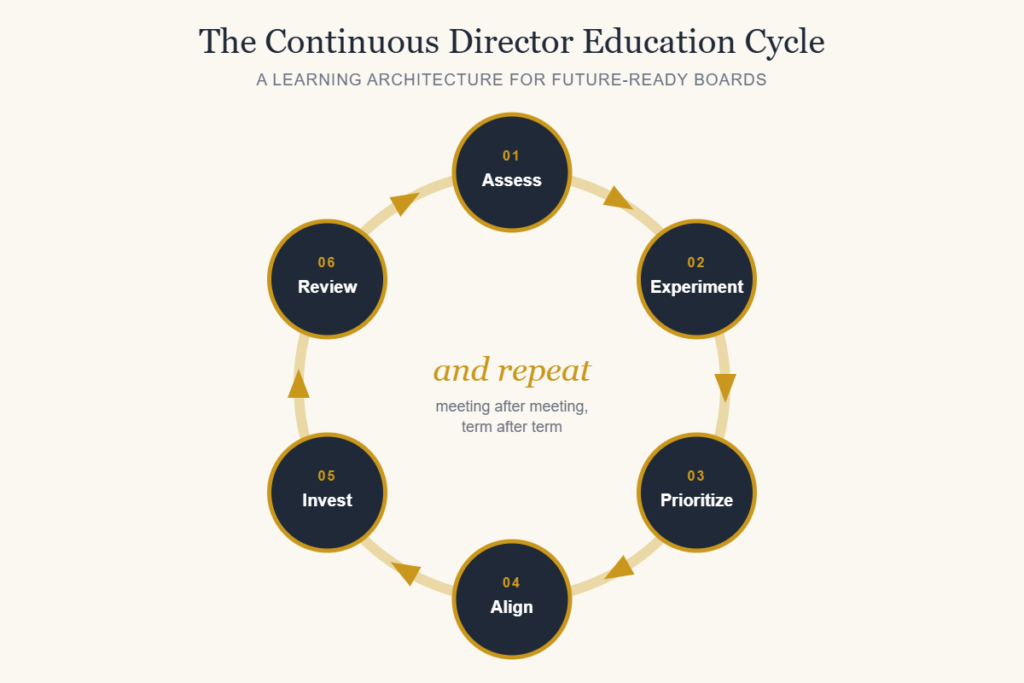
The engine at its center is a simple, repeatable cycle: Assess → Experiment → Prioritize → Align → Invest → Review, and repeat. Everything below runs through it.
Start Before the Ballot, Not After the Seat
Most associations treat director development as something that begins after someone wins an election or accepts an appointment. By then, the expectations conversation is happening backward. You’re explaining the job to someone who has already agreed to do it, sight unseen.
A learning architecture for continuous director education starts earlier. It sets clear expectations about the governance role, the time commitment, and the required learning. And it does this before a candidate joins the ballot or slate.
This isn’t gatekeeping. It’s honesty. A prospective director deserves to know, before they run, that the role involves fiduciary duties of care, loyalty, and obedience. That floor is real, and every director owes it. But the actual job on top of that floor is foresight work. That means asking generative questions, tracing systemic effects, and holding multiple plausible futures at once. It also means partnering with a CEO rather than supervising one.
Associations that disclose this upfront get candidates who opt in with open eyes. Associations that don’t get directors who spend their first year discovering the job was never what they thought. As a result, the board pays for that mismatch in engagement and turnover.
Onboarding Is Chapter One, Not the Whole Book
Once someone takes their seat, the instinct is to compress everything into a single onboarding event covering bylaws, finances, and committee assignments. That event still has to happen. But if it’s the entire learning relationship, the board has mistaken a chapter for the book.
Instead, redesign onboarding as the deliberate start of continuous director education: an ongoing relationship between each director and their own development. The first session should answer one question: “What do I need to know not to cause harm?” That is the compliance floor. It should also set the frame for everything that comes after it. Here is the cadence of learning to expect for the length of your term. Here is who owns it. And here is how it connects to the decisions in front of you.
A new director who leaves onboarding believing they’re “done” has been set up to plateau. By contrast, a new director who leaves onboarding knowing they’ve just started a practice is already inside the architecture.
The Continuous Learning Agenda: Five Capacities Every Director Needs
A learning architecture needs content, and this series has already supplied it. Continuous director education should run across a full term rather than squeeze into a single retreat. Depending on board maturity, it should build these five capacities in sequence or in parallel:
- Disciplined curiosity and generative questioning. Move directors from “did we follow the policy?” to “what might be true in five years that isn’t true today?”
- Systems thinking. Train directors to trace the second- and third-order effects of a decision before they vote on it, not after it backfires.
- Scenario fluency. Build the literacy to evaluate a strategic bet against multiple plausible futures instead of a single forecast.
- Digital and AI literacy. Equip directors to ask governance questions about value, risk, capability, and accountability before any technology proposal reaches a vote.
- Adaptive leadership. Teach directors to tell technical problems from adaptive challenges. Then help them hold a room through productive disagreement instead of resolving it prematurely.
None of these are one-and-done workshops. Each deserves recurring attention: a standing agenda slot, a rotating facilitator, and a short case discussion. Keep reinforcing each one until it becomes how the board naturally operates, not a special occasion it observes twice a year.
Assessment as Diagnostic, Not Report Card
Boards resist assessment because they hear “grade” when they should hear “map.” A Future-Ready Board Assessment works at both the individual and full-board level. It isn’t a scorecard meant to embarrass anyone. Rather, it’s a diagnostic that tells the board where to spend its next unit of learning investment.
The Five Dimensions of a Future-Ready Board
Five dimensions do the work:
- Strategic Focus. How much of the board’s actual meeting time and attention goes to future-oriented strategy versus operational review and reporting.
- Role Clarity. Whether directors consistently distinguish governance from management, and whether the board still occasionally drifts into operating.
- Foresight and Adaptability. Whether the board holds multiple plausible futures in a decision and adjusts as conditions shift, instead of defending a single forecast.
- Decision Discipline. Whether votes reflect traced consequences and named assumptions, or reflect comfort with whoever spoke last.
- Leadership Partnership. The health of the working relationship between the board and the CEO. Is it oversight, or has it drifted into either operational interference or passive deference?
Run this assessment on a cycle; annually is reasonable for most associations. Then treat the results as the starting point for the next round of continuous director education: Assess → Experiment → Prioritize → Align → Invest → Review. They are not a verdict on any individual director’s worth. The point is not to create a perfect board. The point is to create a board that can make better choices about the future.
The CEO Can Set the Table. The Board Has to Eat.
This series has said it before, and the architecture depends on saying it again. The board is responsible for itself and its learning.
The CEO plays a real, necessary role. That includes supplying briefing materials, commissioning outside facilitation, and building the assessment instrument. It also includes scheduling the learning agenda into the calendar. Above all, the CEO creates the conditions for continuous director education to happen within the normal rhythm of board work, rather than as an extra burden. That’s meaningful partnership, and a CEO who does none of it is failing the board.
But the CEO cannot do the board’s learning for it. A board that waits passively for the CEO to drive its development has quietly outsourced its governance. In effect, it has handed that governance to the one person it exists to oversee. That arrangement is backward. It also tends to produce exactly the dynamic Part 2 of this series warned about. That is a board that has stopped stewarding and started depending.
The learning architecture only works if the board treats its own development as its job. The CEO is an essential partner in that work, not its source.
How You’ll Know Your Director Education Is Actually Working
Resist the temptation to measure continuous director education in hours logged or workshops attended. Those numbers tell you the calendar filled up, not that the board changed. Instead, look at decision quality and behavior over time:
- Are questions in meetings sharper and more generative than they were a year ago? Do you hear fewer “did we follow procedure” questions and more “what are we assuming” ones?
- Do the board’s decisions hold up against more than one plausible future? Or do they collapse the moment conditions shift?
- Can the board tell a technical problem it can delegate from an adaptive challenge that requires the board itself to change? And does it do so faster than it used to?
Those are the signals of a learning architecture doing its job. A binder that someone reads once and shelves never produces them, no matter how thorough.
Where This Leaves Us
Eight posts, one argument: most association governance is built for compliance. Yet the moment it’s operating in (brittle, anxious, nonlinear, incomprehensible) requires foresight instead. You cannot buy foresight in a single orientation session any more than you can buy fitness with a single workout. It has to be built, cycle after cycle, by a board that treats its own development as an ongoing capacity. It is not a task the board finishes and moves past.
The architecture in this post is Assess, Experiment, Prioritize, Align, Invest, Review, and repeat. It is not a compliance checklist to file away once you tick the boxes. Instead, it’s a compass a board can use meeting after meeting, term after term. After all, a GPS only knows the routes that already exist. A compass tells you how to move when the map itself changes. Your board’s job is to govern what is next, not to arrive somewhere and stop.
Put Continuous Director Education on Your Next Agenda
So don’t close this series by nodding along. Score your board right now against the five dimensions: Strategic Focus, Role Clarity, Foresight and Adaptability, Decision Discipline, and Leadership Partnership. Then pick the one gap that stings the most. Bring it to your next board meeting as an agenda item, not an aside.
If you’d rather walk through the results with someone who does this for a living, book a Future-Ready Board Conversation. We’ll go through the assessment together and build the first cycle of your board’s learning architecture.
Either way, ask yourself the question this whole series has been circling. The conditions your board governs under will change again. When they do, will your directors have built the capacity to see it coming? Or will you be handing out another binder?
Catch up on the full series:
- Director Education: An Association Imperative
- One Employee: Why Directors Are Oversight Champions, Not Operators
- From Compliance to Curiosity: Teaching Directors to Ask Better Questions
- Systems Thinking for the Boardroom
- Scenario Fluency: Preparing Directors to Govern Multiple Futures
- Digital and AI Literacy as a Governance Competency
- Adaptive Leadership in the Boardroom
I hope you enjoyed this series. For more information, go to my websites at MichaelButeraSpeaks.com and AssociationActivision.com.