
From Compliance to Curiosity: Teaching Directors to Ask Better Questions

Part 3 of 8 — Director Education: An Association Imperative A board is about to vote on a new membership tier. Someone asks whether the pricing fits the budget. Someone else asks whether legal has reviewed the language. A third director asks if this matches what the last member survey said people wanted. Every question […]
One Employee: Why Directors Are Oversight Champions, Not Operators
Part 2 of 8 — Director Education: An Association Imperative Picture the moment in almost any board meeting: a director who has spent thirty years running clinics, managing operations, or classrooms leans into a program update and starts redlining the tactics instead of asking whether the program serves the mission; redlining the tactics, the vendor […]
Director Education: An Association Imperative
An 8-part blog series Part 1 of 8 — Director Education: An Association Imperative A board member spends three days a year reading committee reports, one afternoon at an orientation session, and then sits down to vote on a strategic pivot that will shape the association for a decade. No one in the room asks […]
Mistaking Presence for Power: A Reading List for Association Executives
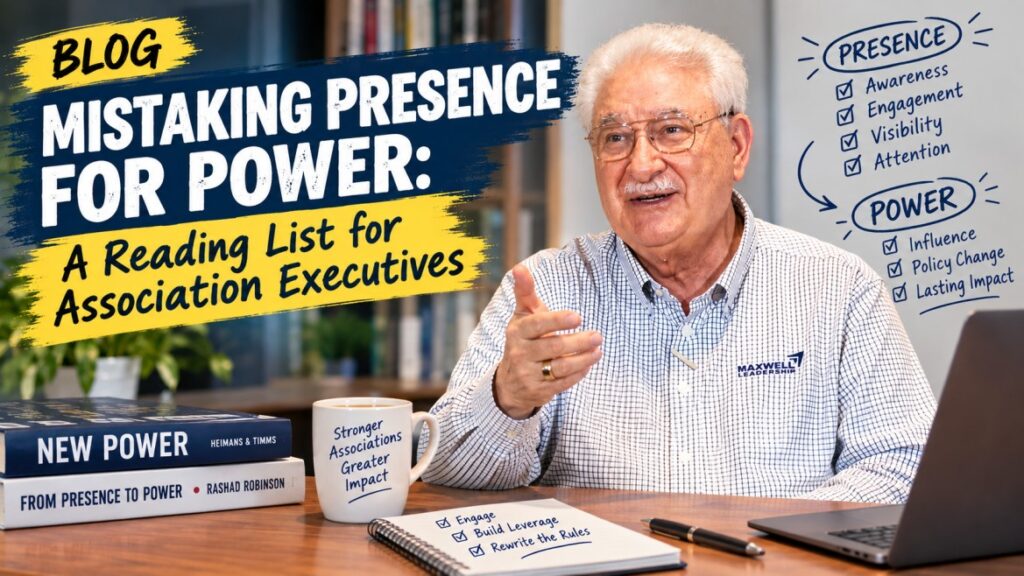
I read two books back-to-back this summer that turned out to be arguing the same point from opposite directions: Jeremy Heimans and Henry Timms’s New Power: How Power Works in Our Hyperconnected World—and How to Make It Work for You (Amazon)(1), and Rashad Robinson’s From Presence to Power: How to Take On the Fights That […]
The Guardrails We Owe Each Other: AI Governance for a Sector Built on Trust
AI Governance for Associations: The Guardrails We Owe Each Other Geoffrey Hinton, the man who helped invent the deep learning that underpins today’s AI boom, now puts the odds of the technology “taking over humanity” somewhere between 10 and 20 percent (TechNewsReel). At Davos this year, Yoshua Bengio, another of the field’s founding minds, described […]
From Surveillance to Stewardship: Designing Smarter Accountability Systems for Associations -Part 3 of 3
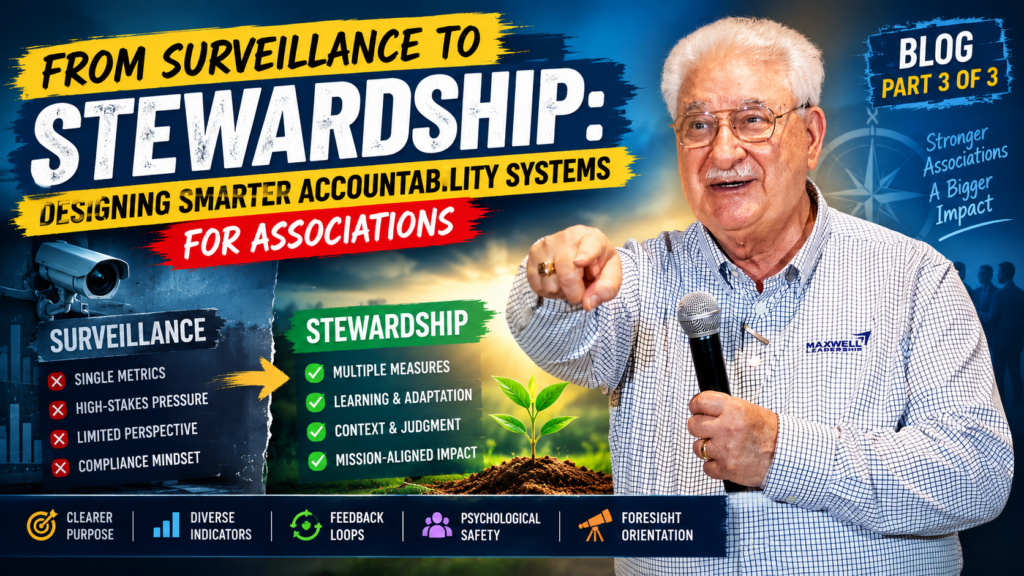
The lesson of No Child Left Behind is not that accountability fails—it is that poorly designed accountability systems do. ¹ ² The first part of this series explored the seduction of simple metrics. The second examined how those metrics, once tied to pressure and consequences, can distort behavior. The third and most practical question is […]
When Accountability Backfires: How No Child Left Behind Distorted Behavior—and What Boards Should Notice : Part 2 of 3
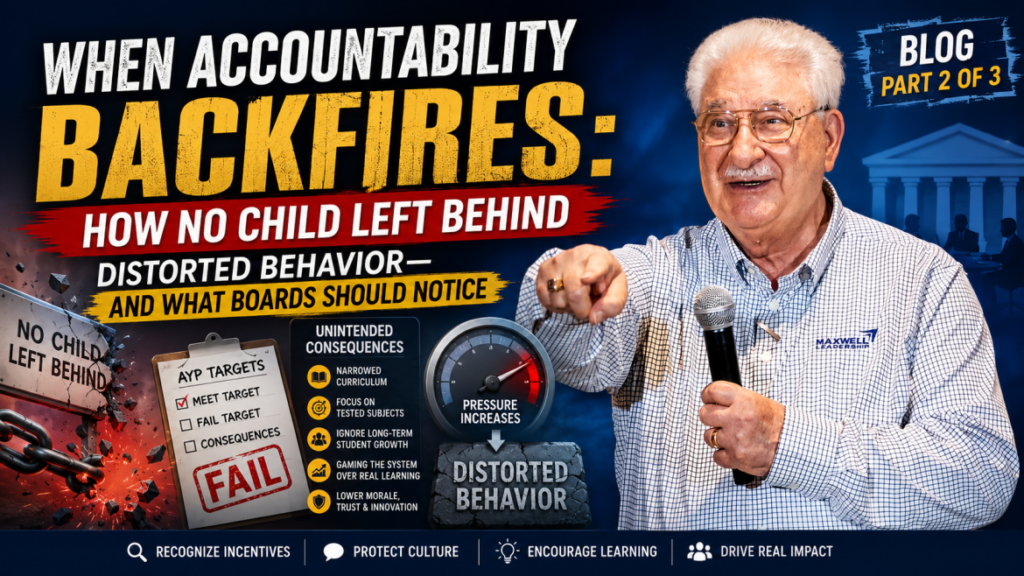
Accountability is not neutral. It shapes behavior, sometimes in ways we neither anticipate nor intend. In the first part of this series we discussed “No Child Left Behind, accountability, metrics, governance, and lessons for association leaders.” No Child Left Behind did not falter because it lacked rigor. It faltered because it underestimated how systems respond […]
When Metrics Take the Wheel: What No Child Left Behind Teaches Associations About Accountability -Part 1 of 3:
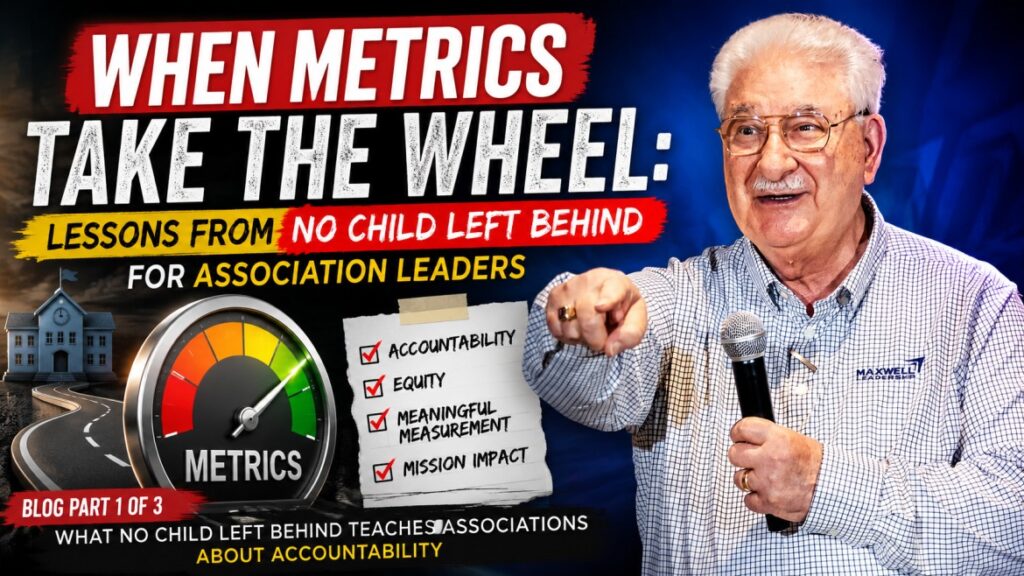
When Metrics Take the Wheel: What No Child Left Behind Teaches Associations About Accountability In public education, No Child Left Behind brought accountability to the center of national policy. It did so for understandable reasons: inequities were too often obscured, and leaders wanted a system that would make performance visible and gaps harder to ignore. […]
From Insight to Action—Embedding Scenario Planning in Governance – Part 4 o 4
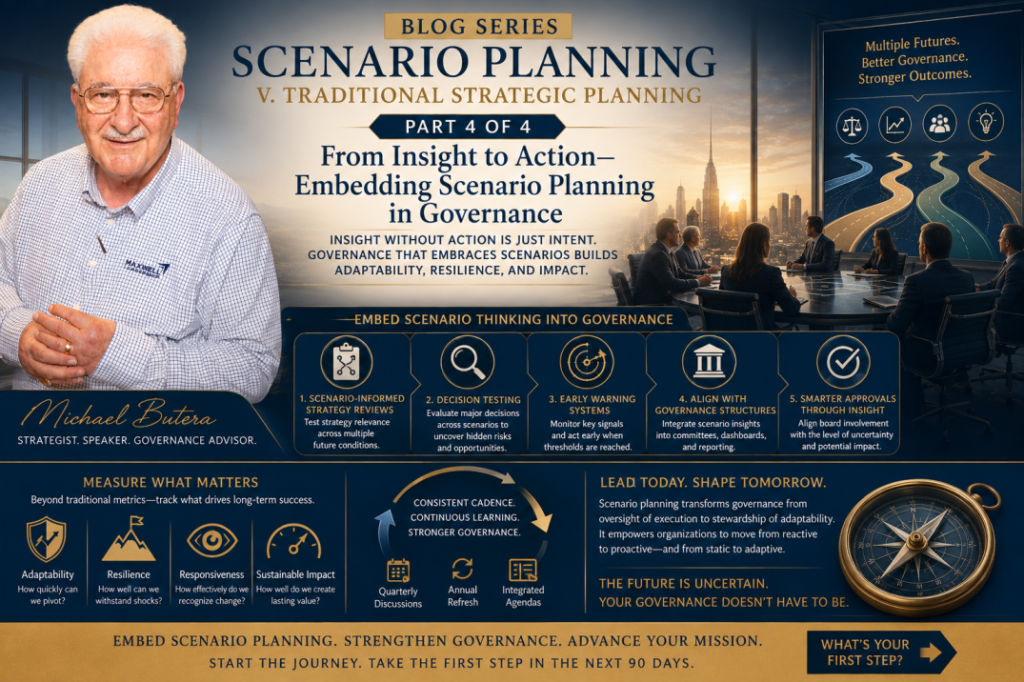
The value of scenario planning is not in the exercise itself; it lies in the changes that result from it. Too often, organizations treat scenario planning as a one-time exercise: a workshop is held, scenarios are developed, insights are captured, and then existing processes continue largely unchanged. When this happens, the impact is limited. The […]
Building Systems Thinkers in the Boardroom – Part 3 of 4
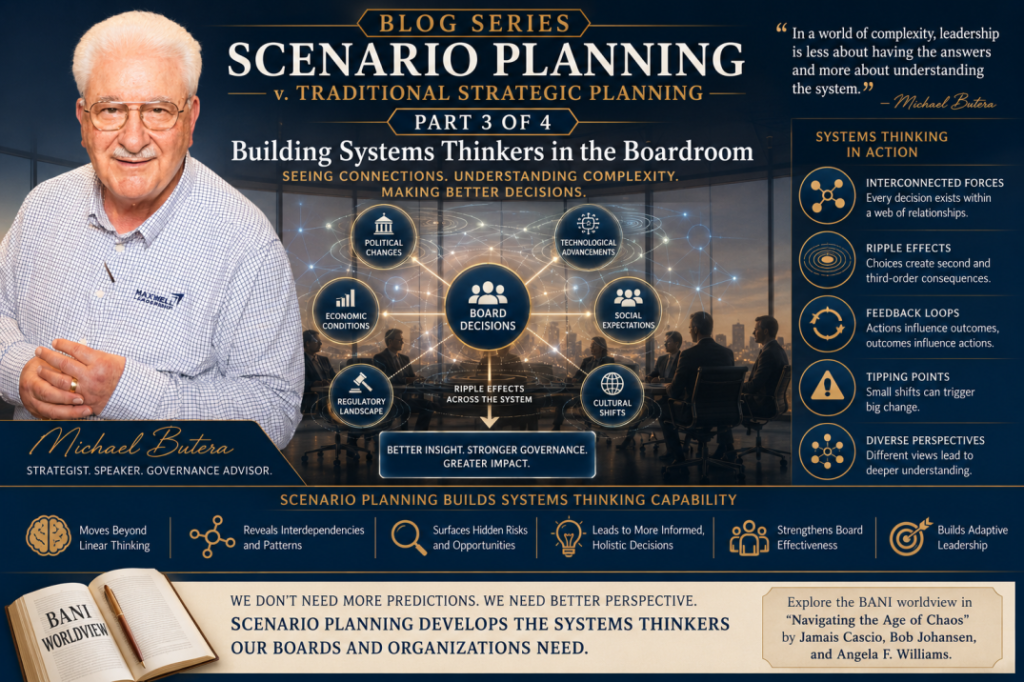
One of the most underappreciated outcomes of scenario planning is its impact on how leaders think. Not just what they decide, but how they understand the world in which those decisions are made. I have become a strong believer in the BANI worldview. I hope you will find time to explore the BANI concept more […]