
BLOG – Part 3 of 6 – Accelerated Exits: Succession Planning in the Age of Constant Change
In a world defined by acceleration, the length of executive tenures is shrinking. Many association CEOs now stay in their roles just 4.5 to 7 years. Some depart due to burnout, others are recruited elsewhere, and still more leave when transformation efforts run aground. Succession is no longer an if—it’s a when. And it’s happening […]
Part 2 of 6 – Redefining the Role: From Curation to Creation in the Executive Director Seat
The Executive Director (ED) (CSO) has historically been viewed as the person tasked with maintaining programs, managing staff, and preserving organizational history. But as disruption becomes the norm, that orientation is no longer sufficient. The association executive of the future must not only maintain the house but also be willing to redesign it. The ED […]
Why Strategic Planning Fails—and What Associations Must Do Instead
Strategic planning has long been a mainstay of association management. Every few years, boards and staff gather to define goals, outline priorities, and chart a course for the future. Yet, despite the effort, many associations find themselves no more capable, adaptive, or aligned after the plan is written than they were before. Why? Because strategic […]
Leading in the Age of Disruption – Part 1 of 6 – Leading from the Edge: Adaptive Leadership for the Next Era of Associations
Associations are facing a cascade of disruptions: accelerated technology, shifting demographics, political polarization, and evolving member expectations. In this new environment, the old rules of leadership no longer apply. Stable environments have favored predictable planning, incremental improvement, and control-oriented management. But stability is no longer the norm. What’s needed now is adaptive leadership—a framework built […]
Is “Breaking” – Broke?
Have you ever noticed how many times a day you’re interrupted by a push notification that screams “Breaking News!”? Whether it’s from a cable news network, a news app, or a social media platform, these alerts come at us like sirens in the night—loud, frequent, and anxiety-inducing. But here’s the real question: When was the […]
Behaving for the Future: Embracing New Power in Association Leadership

The nature of power is changing. In New Power, authors Jeremy Heimans and Henry Timms argue that old power is like a currency—held by few and spent carefully—while new power behaves more like a current, open, and participatory, gaining strength as more people contribute. For associations, this shift offers both a challenge and an opportunity. […]
Stability in an Unstable World: Why Associations and Government Must Support Research and Higher Education

In today’s BANI world—Brittle, Anxious, Nonlinear, and Incomprehensible—change is relentless, systems fracture unexpectedly, and certainty is a vanishing luxury. In such an environment, research and higher education function as stabilizing forces. They build adaptive capacity, generate critical insight, and prepare society for volatility. For associations and governments alike, supporting these institutions is not simply a […]
Honoring Freedom: Why Associations Should Celebrate Juneteenth
Introduction: Juneteenth—celebrated each year on June 19—marks the day in 1865 when the last enslaved African Americans in Galveston, Texas, learned they were free over two years after the Emancipation Proclamation. Now recognized as a federal holiday, Juneteenth is more than a commemoration of delayed freedom; it is a day to honor Black Americans’ resilience, […]
Remember Memorial Day 2025
Remember Memorial Day 2025 A Time to Reflect, Honor, and Serve On this Memorial Day, we pause to honor and remember the brave men and women who gave their lives in service to our country. Their sacrifice is a solemn reminder of the cost of freedom and our enduring responsibility to uphold the values they […]
When Process Becomes the Problem – Rethinking Association Structures for a New Era
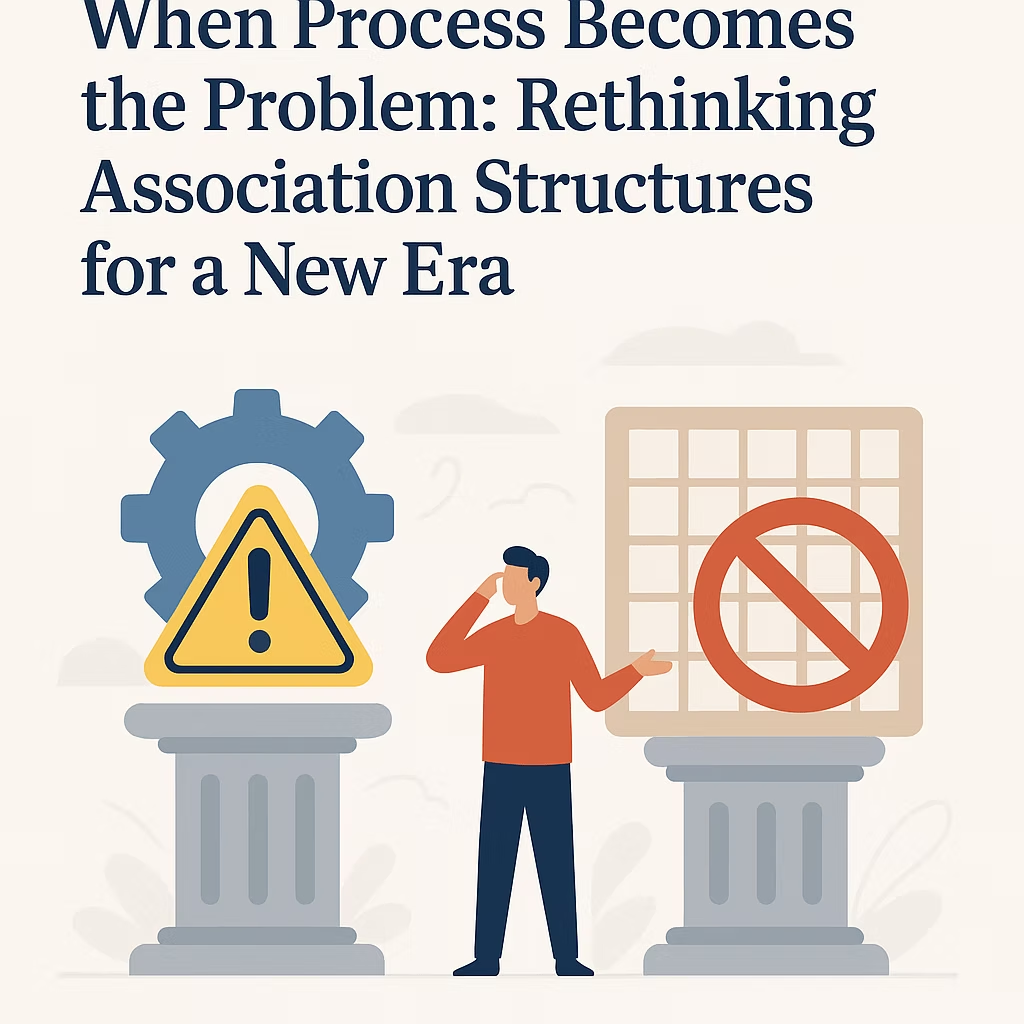
In Abundance, Peter Diamandis and Steven Kotler make a provocative point: many of today’s most persistent challenges stem not from failure, but from the unintended consequences of yesterday’s solutions. Procedures, rules, and structures designed to fix problems or ensure fairness decades ago now often stand in the way of progress. This tension is especially visible […]